Phone:
(701)814-6992
Physical address:
6296 Donnelly Plaza
Ratkeville, Bahamas.
Businesses heavily rely on web applications to provide seamless digital experiences in today's technology-driven world. Developers who are able to construct complete applications—from the user interface to the server and database—are needed by businesses in a variety of sectors, including e-commerce platforms, banking applications, healthcare systems, and enterprise software. Full-stack development is now one of the most in-demand career paths, and Java remains one of the most dependable technologies for developing scalable and secure applications.
Best AI Courses in Ghaziabad for Full Stack Developer, Java Developer, and Java Full Stack Developer are terms you may have heard if you want to start a career in software development. But what exactly is Java Full Stack, and why is it regarded as one of the best career paths for developers who want to work in the field?
This guide will help you learn everything you need to know about Java Full Stack development, including the technologies involved, the learning path, the skills you need, career options, and how taking a Java Full Stack Development course can help you become a professional ready for the industry.
To understand what full-stack Java is, let’s first break the term into two parts.
Enterprise applications, web applications, mobile applications, and cloud-based solutions all make extensive use of Java, a powerful object-oriented programming language. It is well-known for its dependability, security, scalability, and independence from platforms.
The ability to create a web application’s frontend and backend simultaneously is referred to as “full stack.”
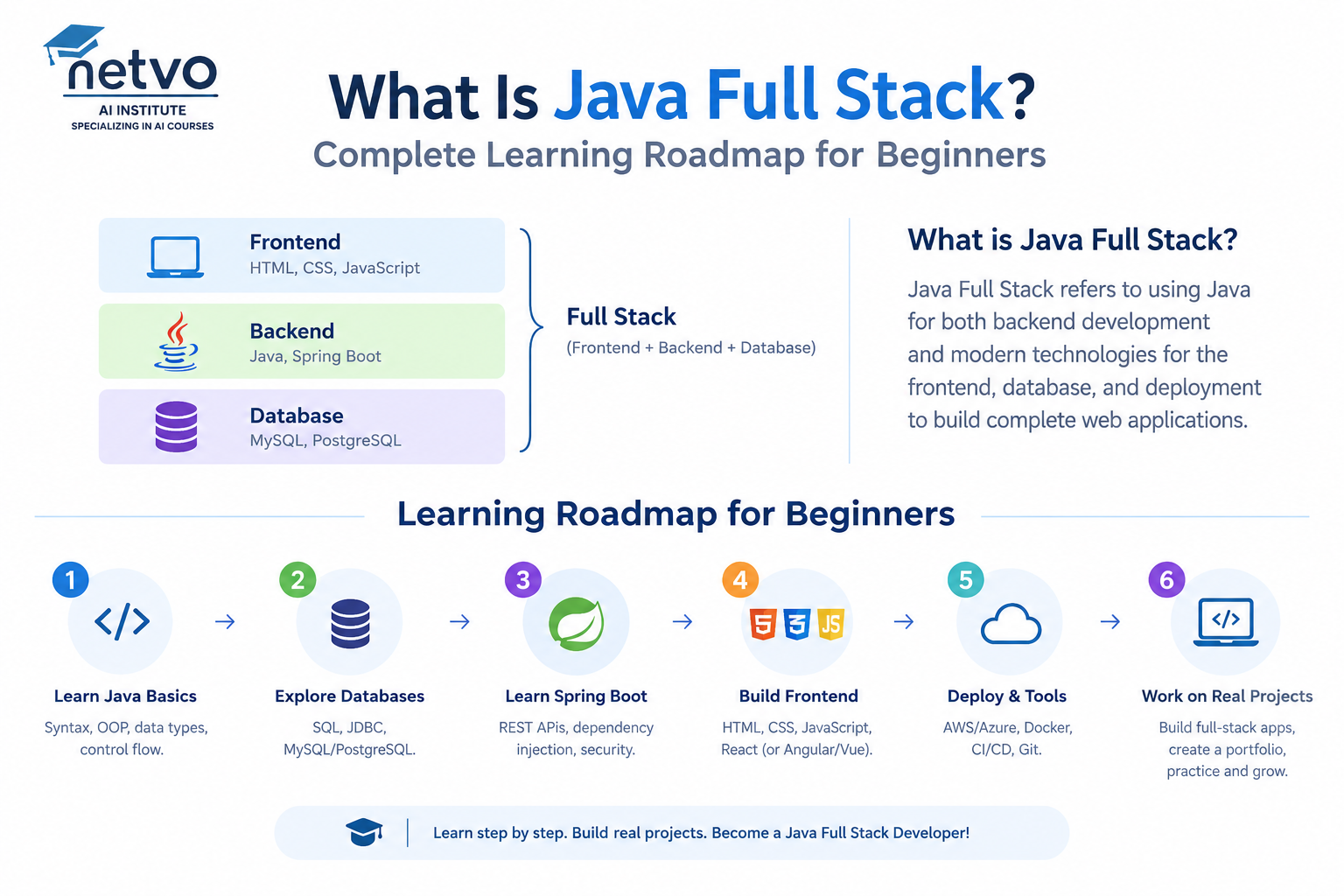
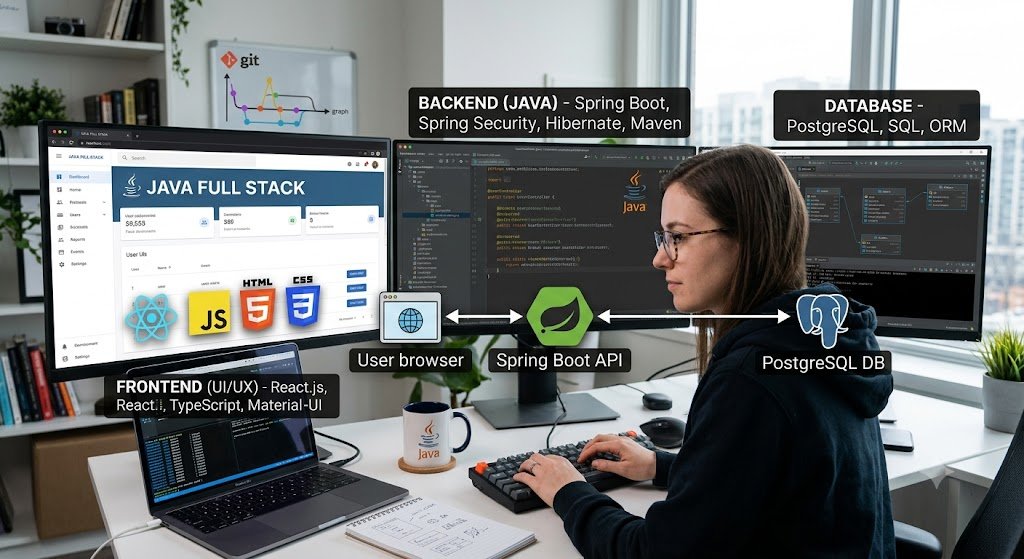
A professional who is able to build an entire web application using Java for backend development and frontend technologies like HTML, CSS, JavaScript, React, or Angular is known as a Java Full-stack Developer. They also manage application integration, version control, deployment, databases, and APIs.
A Full Stack Java Developer is highly valuable to employers in all industries because they understand the entire software development lifecycle rather than just one area.
Java has remained one of the most popular programming
languages for more than two decades despite rapid technological change. Java is
still used by startups, large businesses, government agencies, financial
institutions, and healthcare organizations due to its stability and
performance.
Students benefit from learning Java full-stack programming because they learn multiple skills rather than just one technology.
The following are some of the main reasons why it is so popular:
Professionals with Full-Stack Java skills are always in demand because Java powers thousands of enterprise applications worldwide.
A Java full-stack developer works on all application layers, from creating user-friendly interfaces to secure backend systems.
The most important duties include :
Exposure to a variety of widely used software industry
technologies is one of the greatest benefits of learning Java Full Stack.
Frontend Technologies
Technologies for Front End Everything that users directly interact with is the frontend. It focuses on developing interfaces that are responsive, visually appealing, and easy to use.
HTML5
CSS3
JavaScript
Bootstrap
React
Angular
Web applications and websites that work well on desktops,tablets, and smartphones are made possible by these technologies.
Technologiesfor the Backend
The application’s business logic is managed by the backend. It handles requests, connects to databases,and ensures the safe handling of data.
Backend technologies that are common include:
Basic Java
Java Advanced
Spring Foundation
Winter Boot MVC
Spring Hibernate
APIs in REST
Because it simplifies enterprise application development and significantly cuts development time, Spring Boot has become the industry
standard.
Database Management Systems
A database is required Typically, Java developers work with:
MySQL
PostgreSQL
Database from Oracle
MongoDB
An essential part of becoming a Full Stack Java Developer is learning SQL, database design, indexing, and query optimization.
Tools for Development
A number of tools used in modern software development also increase productivity.
These are some:
Git
GitHub
Maven
Gradle
Postman
IDEA in IntelliJ
Eclipse
Code with Visual
Studio
Developers should be able to use these tools easily in collaborative settings, according to employers.
Learning programming languages isn’t enough to be successful in Full Stack Development. Professionals who are adept at problem-solving, codewriting, and development team collaboration are sought after by employers
The following are some of the most critical technical abilities:
Programming with Objects in Mind Algorithms
Data Structures CSS and HTML JavaScript
SQL
Programming in Java Winter Boot Hibernate
Development of a REST API Git for version
control Management of databases
The Basics of the Cloud Techniques
Debugging Deployment of Applications
Soft skills are also very important. Developers perform better in real-world projects and interviews when they have excellent communication, analytical thinking, teamwork, adaptability, and problem-solving skills.
Because Java Full Stack covers multiple technologies, many novices feel overwhelmed. The good news is that following a planned path to learning makes it much simpler.
Typically, the journey begins with Core Java, where you learn fundamental programming concepts like variables, loops, functions, classes, objects, inheritance, polymorphism, handling of exceptions, collections, and multithreading. It is essential to establish a solid Java foundation because these ideas are the foundation of every advanced framework.
Learning database management is the next step once you are familiar with Java. You will be better able to create applications that efficiently store and retrieve information if you have a solid understanding of SQL, CRUD operations, joins, normalization, and relational database concepts.
Learn HTML, CSS, JavaScript, Bootstrap, and a modern JavaScript framework like React or Angular to focus on frontend development after databases. You can make interactive and responsive user interfaces with the assistance of these technologies. Before moving on to Spring Framework and Spring Boot, which simplify enterprise application development.
The following phase includes Advanced Java concepts like Servlets, JSP, JDBC, and session management.
Finally, to be completely industry-ready, learn how to develop REST APIs, use Git, Maven, and Docker, as well as cloud platforms like AWS.
The company, location, technical expertise, and project experience all influence salary. Java Full Stack, on the other hand, continues to be one of the most lucrative technology fields. In India.
Typical salary ranges include:
Newcomers: between 4 and 7 LPA
Two and four years of experience: 7 LPA to 12 LPA
5 or more years of experience: 12 to 20 LPA or more
Higher pay packages are frequently offered to professionals who are proficient in modern frontend frameworks, cloud computing, DevOps, Spring Boot, and microservices.
While it is possible to learn on your own, a structured Java full-stack development course provides expert mentorship, practical assignments, and exposure to the real world.
Students benefit from a quality training program in:
Learn in a predetermined order
Create real-world projects for the industry
Receive guidance from knowledgeable trainers
Enhance your problem-solving and coding abilities
Get yourself ready for technical interviews
Create a portfolio for professionals
Gain assistance with placement
Students are able to become job-ready faster and the learning curve is significantly reduced as a result.
Absolutely. Java is still the most widely used programming language for enterprise software development, even though newer frameworks and programming languages have emerged.
Because of its stability, security, scalability, and extensive ecosystem, businesses continue to invest in Java. The demand for Full Stack Java Developers is anticipated to remain strong for many years to come as businesses increasingly adopt cloud computing, digital transformation, and enterprise automation.
Java FullStack is an excellent option for students looking for a career that is secure for the future and offers excellent opportunities for advancement.
Knowing what it takes to start a successful career in software development is the first step. One of the most adaptable IT professionals is a Java Full Stack Developer, who can create APIs, create responsive user interfaces, develop secure backend systems, manage databases, and deploy applications. Professionals who are proficient in programming will continue to be in high demand as businesses continue to invest in digital solutions. Investing in a full-stack Java developer course can open the door to exciting career opportunities across industries, whether you’re a student, graduate, or working professional looking to upskill.
We at netvo ai Education provide industry-focused Java Full Stack Training with expert-led sessions, hands-on projects, interview preparation, certification guidance, and dedicated placement assistance to help students master the latest technologies. Join Netvo AI Education and take the first step toward becoming a self-assured and employable Java Full stack Developer if you are ready to build a rewarding career in software development.
1.How
does Java Fullstack work?
Java full-stack means using Java, technologies
like HTML, CSS, JavaScript, React or Angular, Spring Boot, databases, and REST
APIs to build both the frontend and backend of a web application.
2.
What is the purpose of Full Stack Java?
It is used to create cloud-based business
applications, complete web applications, enterprise software, banking systems,
healthcare platforms, e-commerce websites, and more.
3. Is
Java Full Stack challenging for novices?
No.
Even without prior programming experience, beginners can successfully
learn Java Full Stack with a structured learning approach and regular practice.
4.How
much time is required to master Java Full Stack?
Through consistent instruction, practical
assignments, and live project experience, most students become job-ready within
five to eight months.
5.
Java Full Stack or Python Full Stack is superior?
Both have excellent job prospects. Enterprise
applications typically use Java Full Stack, whereas startups, automation, and
AI-related projects typically use Python. The best option is determined by your
career objectives.
Phone:
9891516661
9911027722
Physical address :
C-53, IDFC Bank, Sharnam Plaza, near Indian Oil Petrol Pump, RDC, Block 1, B-Block, Raj Nagar, Ghaziabad, Uttar Pradesh 201001
Email address : info@netvoinstitute.com